A place in the story
Kakum National Park Canopy Walkway
A rainforest park where a narrow walkway turns the canopy into a lesson about height, habitat and care.
Narration available · 2 min
Listen to the story
Kakum National Park Canopy Walkway, narrated.
Read transcript
A rainforest park where a narrow walkway turns the canopy into a lesson about height, habitat and care.
The forest below. Kakum begins with what is easy to miss from the road: a dense forest holding many layers of life at once. Roots, trunks, vines, insects, birds and shade share the same space, but not the same view. The park sits inland from Cape Coast, in a part of Ghana where the forest has long shaped work, medicine and movement. Before the walkway becomes the headline, the trees set the terms. You are entering a habitat, not a stage built only for visitors.
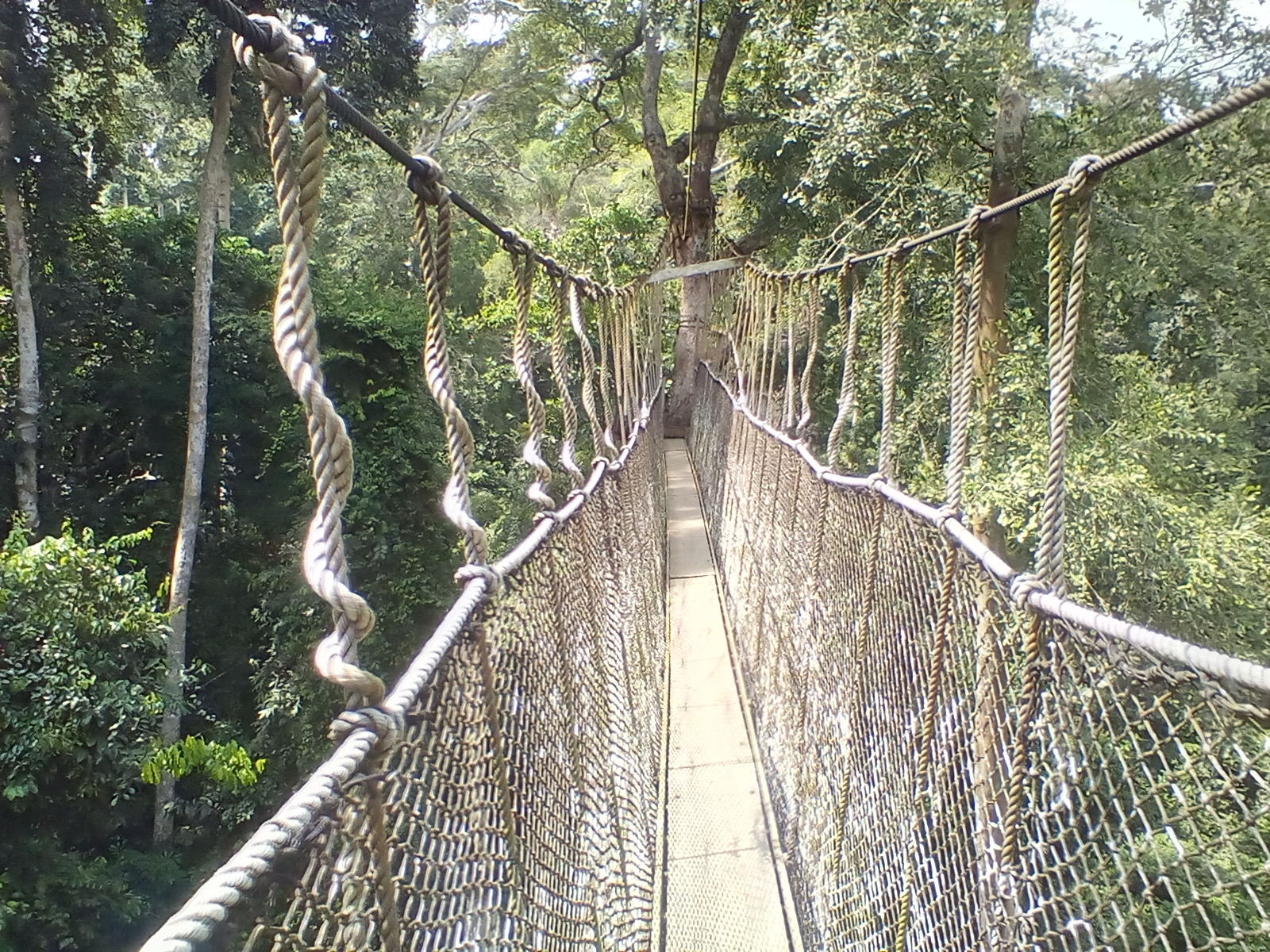
A path above the trees. The suspended canopy walkway changes the scale of the visit. From the ground, the forest can feel like a wall. From the bridges, gaps open between leaves and the landscape becomes legible in another direction. The height brings excitement, but it also makes the canopy's value visible. Forest protection is not abstract when you can see how much life sits above eye level. The walkway is a visitor structure inside a protected area, not proof that the forest exists for entertainment.
What the height changes. Kakum works best when the thrill leads to attention. Listen for birds, notice how the air changes, and let a guide explain what the park protects. The experience belongs beside a larger question: how can tourism pay for conservation without reducing a living forest to one photograph? That question connects the park to Ghana's environmental choices, local livelihoods and the future of the Central Region. Leave with more than a story about being brave on a bridge. Leave knowing what the bridge is asking you to protect.
Kakum makes Ghana's rainforest visible from a new angle while keeping conservation at the centre of the visit.
The forest below
Kakum begins with what is easy to miss from the road: a dense forest holding many layers of life at once. Roots, trunks, vines, insects, birds and shade share the same space, but not the same view. The park sits inland from Cape Coast, in a part of Ghana where the forest has long shaped work, medicine and movement. Before the walkway becomes the headline, the trees set the terms. You are entering a habitat, not a stage built only for visitors.
A path above the trees
The suspended canopy walkway changes the scale of the visit. From the ground, the forest can feel like a wall. From the bridges, gaps open between leaves and the landscape becomes legible in another direction. The height brings excitement, but it also makes the canopy's value visible. Forest protection is not abstract when you can see how much life sits above eye level. The walkway is a visitor structure inside a protected area, not proof that the forest exists for entertainment.
What the height changes
Kakum works best when the thrill leads to attention. Listen for birds, notice how the air changes, and let a guide explain what the park protects. The experience belongs beside a larger question: how can tourism pay for conservation without reducing a living forest to one photograph? That question connects the park to Ghana's environmental choices, local livelihoods and the future of the Central Region. Leave with more than a story about being brave on a bridge. Leave knowing what the bridge is asking you to protect.
Why this place matters
Kakum makes Ghana's rainforest visible from a new angle while keeping conservation at the centre of the visit.
Visiting with care: Wear secure shoes, carry water and follow the guide's instructions on the walkway and in the forest.
Where this is today
Kakum National Park Canopy Walkway
Central Region · Exact surviving site
Open modern mapSources
Read the references behind this story.
Image credit: DaSupremo via Wikimedia Commons · Image source
 Continue to Elmina CastleElmina CastleA fortified gold-trading centre whose changing uses became part of Atlantic slavery and its memory.